When I wrote my first book, I felt like I had it relatively easy. I pored over my field books, journals, and archived emails. Dug up old paperwork. Did some interviews, and read a lot of books. I also talked to people who were there when things happened, to check if my memory was similar to theirs. But ultimately I was writing what I knew, what I’d done, what I’d thought. I was writing from a place of extensive personal knowledge, and didn’t need to think too hard about how to structure the narrative (chronologically), or where to put chapter breaks (after each field season), or how to end it (on an ambiguous but relatively positive note).
I thought I could use that same process on my next book. But as I learned on a mini-writing retreat to the mountains, it’s a lot different. For one thing, I brainstormed my ideas with pen and paper, creating mind maps that have a central theme or idea with sub-themes/ideas branching out from them. I’ve mapped out the structure of the book into three sections. I’ve also mapped out the content of each section at six or seven essays each.
This is far from how I’m used to writing, where I just jump in and see what comes out of my pen (or keyboard). I’m not usually a plotter like this—I’m more of a pantser (flying by the seat of my pants). But I’m finding that I can’t put this book together without having a strong backbone to work with. If I pants it, it won’t cohere. Besides, I can always change things as I go. I’ve already moved two essays from one section to another, and it makes me feel a bit better that I can make those changes and the plot isn’t set in stone.
I’ve also been writing longhand in my notebook, putting together my thoughts for each essay on the page before transcribing it into Word. Which is quite the adventure, as my writing is so terrible that sometimes I can’t even read it! But it seems to help to put pen to paper—my writing is more immediate and not filtered through the clinical space of a cursor and a blank document.
One thing about all this planning is that it’s changed the focus of my book. What I originally thought I’d write about is sort of a 90 degree turn to what I’m actually going to write about, and that became clear when I created the mind map of the overall book structure.
I had planned to write about a year on the trails, what I observed, how it changed me, the people (and dogs) I met, and what I felt on the trail. But I had weeks when I didn’t get out on the trail, because I wasn’t feeling well or was injured. Also, when I did manage to get on the trails, I had some troubling emotions while out.
I realized I needed to write about my mental illness in general, and my experience in the outdoors in particular. So my book is about having bipolar II, whether or not being in nature can actually cure it, and how I can build a good life for myself despite my limitations, taking into account my experiences in nature.
I don’t know if anyone will be interested in it. Memoirs in essays are a hard sell apparently. But at this point I’m not concerned with who will buy or read it. It’s what I want/need to write, and so I’ll plug away at it over the next months (years?) and see how it goes.
In terms of writing process, this will take more research and reading to pull together. I’m not just writing what I know or what I did—I’m writing about how things are for people with mental illness. I have to get on top of the literature around diagnoses and medication: are medications being overprescribed by family doctors who think depressive symptoms are always due to depression itself? What about the “nature cure:” Can it actually cure illnesses or is it just a nice stress-reliever to be out in the woods? Then there’s the experience of others with bipolar II: What have they found is the best way to live with it?
In my research I’ve already found a number of books I’d never heard of that are about living with a mood disorder (good comparable titles for a book proposal). I also have an acquaintance with mental illness who has been writing about how nature doesn’t cure her illness, but can give her a bit of peace of mind, so I’ll definitely be talking with her.
All of this is to say that not every book has the same process. Sometimes it’s harder to write a second book when it’s so different than the first. You not only have to consider your content, but also how you want to tackle it and shape it into a readable form.
For example, I have a friend who’s writing her second book. It’s research-heavy, and she needs to read a lot across disciplines to make it work. Like me, her first book was a memoir, and so she’s had to rethink her process for this second book. The kicker is that she has kids who require different things from her than they did when she was writing her memoir. This sometimes conflicts with what she needs to get her book written: she needs longer periods of time to write steadily, and can’t snatch a paragraph here or a few sentences there. It’s tough, but she’s starting to see a way through it.
I’m starting to see a way through to my book, too. I hope I can keep the process going to get it done.
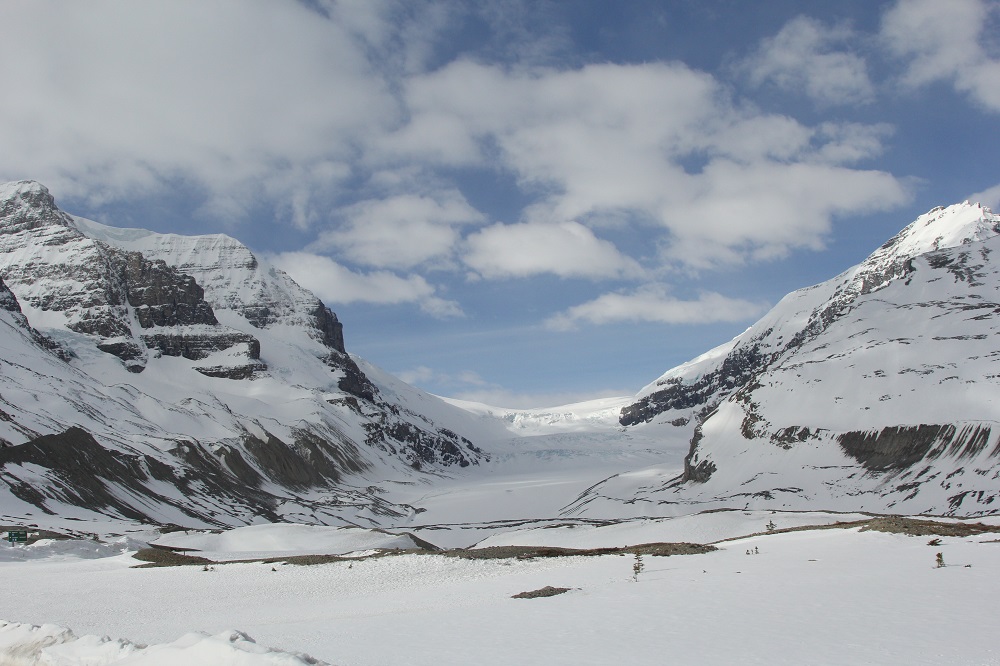
*The image at the top of the page is the Athabasca Glacier in April of 2026.


